

Dawn is the first in the world - for the first time ever - to bring detection to the access phase itself: AI-driven, dynamic, and free of static rules. Read our story!


Every breach is an access event
Every week or so, I sat down with a CISO, and I asked the same three questions.
Can you honestly tell me where your company's sensitive assets are? Can you tell me who touched them? And can you tell me whether they should have?
The answers were sorted into two groups.
The first group didn't bother trying. They said no, flatly, and then said that anyone telling me otherwise is lying - The majority of the CISOs.
The second group tried. They walked me through their classification project, their audit reviews, their roadmap. Then, usually within a few minutes, they stopped and admitted that in the AI era this simply is not a question anyone can answer.
Both groups were saying the same thing. One was just quicker about it.
Every data exposure, at its core, is an access attempt. Somewhere, an identity - a person, a service account, an AI agent - touched a data asset it should never have touched. And in the overwhelming majority of modern intrusions, that access looked completely legitimate to every security tool that is currently out there.
That single, uncomfortable fact is why we founded Dawn.
In the AI era, being safe means achieving resilience and trust: ensuring that your company can continuously protect its intellectual property, maintain regulatory compliance, and deploy AI technologies without exposing the network to catastrophic vulnerabilities.
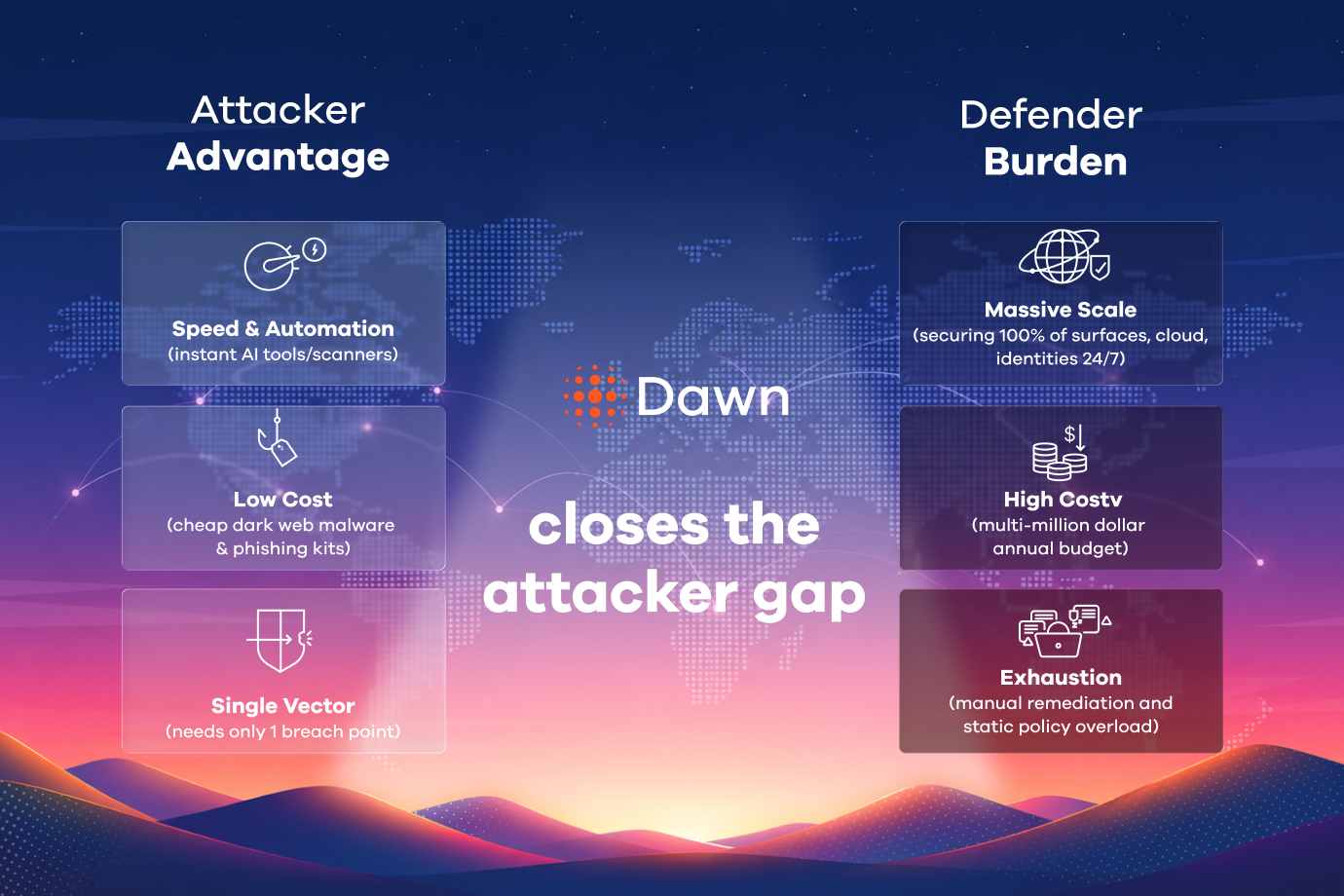
For more than 2 decades it's been an ongoing race between the defender and the attacker. Modern security teams navigate a deeply asymmetric operational landscape. Even with enhanced visibility across infrastructure, adversaries maintain a fundamental structural leverage: organizations must continuously secure every surface, while threat actors require only a single compromised vector to breach the environment.
Across the AI era, this exposure has expanded dramatically. The accelerating volume and complexity of autonomous exploits render manual remediation insufficient for maintaining comprehensive defensive posture.
The history of cybersecurity is a history of arriving one domain late. In 1993, Check Point was founded, and in 2005, Palo Alto Networks followed - the era of the network. It began with network detection and response (IDS) and quickly evolved into prevention (IPS), all in service of one mission: bringing security to the network domain.
Then the same story replayed on the endpoint. CrowdStrike was founded in 2011, Cylance in 2012, SentinelOne in 2013 - each racing to detect threats where the network tools couldn't see. The attack landscape shifted dramatically in 2014–2016, when waves of ransomware campaigns hit enterprise organizations and the market moved into "assume breach" mode - threat hunting, detection of lateral movement. A few years later, the pendulum swung from detection and response back toward prevention, and then the industry tried to shift left once more - this time with Data Detection and Response (DDR).
After a decade of network focus and a decade of endpoint focus, in 2020–2021 the frontier moved again: DSPM emerged, and companies like Cyera, Laminar, and Dig were founded. Data posture was mapped; data threats were never truly detected in motion.
Dawn is the first in the world - for the first time ever - to bring detection to the access phase itself: AI-driven, dynamic, and free of static rules. Let us show you why this layer is where the battle will be decided, and how the technology we've built works.
Every data breach, at its core, is an access event. Somewhere, an identity - a person, a service account, an AI agent - touched a data asset it should never have touched. And in the overwhelming majority of modern intrusions, that access looked completely legitimate to every security tool watching it.
The question nobody can answer - Was this access legitimate?
IAM knows who has permission, but has no understanding of the business context of the data being accessed. Data security tools know what the data is, but have no profile of the identity consuming it. Both rely on static policies and pre-provisioned permissions - snapshots of intent taken months or years before the access actually happens. The result is an enterprise that is simultaneously over-permissioned, under-protected, and out of compliance, without knowing it.
The dots can no longer be connected by hand
Even if a security team wanted to close this gap manually, the math has become impossible.
And AI agents are pouring fuel on the fire. The average enterprise already runs over a hundred SaaS applications, and Gartner projects that by 2028, a third of enterprise software will embed agentic AI - up from less than 1% in 2024. Every one of those agents is a new identity that authenticates, inherits permissions, and consumes data at machine speed. GenAI adoption doesn't just expand the attack surface; it multiplies the number of trusted actors whose behavior no human can review.
Three exponential curves - data, identities, and AI agents, intersecting on top of a policy model designed for a world of employees and file shares. It is simply impossible to connect the dots with static rules and human review. Something fundamentally different is required.
The security industry's answer to this complexity has been behavioral analytics: learn a baseline of "normal" activity, then flag deviations. It sounds reasonable. In practice, it fails in two structural ways.
First, it is fundamentally reactive. A behavioral system waits for an agent to consume data, and only then evaluates that consumption against a learned baseline. By the time an anomaly is scored, the data is already gone. The manifold of "normal" is always a description of the past.
Second, anomaly detection drowns defenders in false positives. When access events are examined in isolation, data science is constrained to asking "is this unusual?" - and in a modern enterprise, almost everything is unusual. New agents, new integrations, new datasets appear daily. Legitimate work constantly looks anomalous, and sophisticated attackers deliberately look normal. The signal-to-noise ratio makes the approach impractical at exactly the scale where it's needed most.
The deepest flaw is philosophical: unusual is not the same as illegitimate, and usual is not the same as safe. An adversary using valid credentials inside an approved SaaS integration is, by definition, behaving normally.
Dawn operates on a fundamentally different and, we believe, superior model: reasoning based on necessity.
Instead of asking "does this look like the past?", Dawn asks "does this access make sense at all?" - and it can ask that question ahead of consumption. When the nature of a data asset changes - new content, new sensitivity, new business purpose - the system itself reasons about whether access should be triggered, by whom, and why. Protection moves upstream of the breach instead of trailing behind it.
An agent, defined by an access profile - its function, its purpose, the nature of its work. Dawn is deliberately agnostic to what kind of identity that agent is: a human user, a machine workload, or an AI agent are all just agents with profiles.
A data asset, defined by a data profile - what the data is, what it's for, and who genuinely needs it.
Legitimacy becomes a question of alignment. Access is legitimate only if the attributes of the access profile align with the attributes of the targeted data. A mismatch is not merely an anomaly - it is a strong, explainable signal of a potential data breach.
And critically: there are no policies. No rules to author, tune, or let rot. Building rich access and data profiles is a hard problem, and reliably assessing their alignment is harder still - but recent advances in AI have made this reasoning tractable for the first time. That is the unlock we built Dawn on.
Dawn - a complete, AI-driven Access Intelligence Layer that safeguards data assets from illegitimate post-authorization access. It sits where the industry's blind spot lives: after the login succeeds, after the token is granted, after every existing control has already said "yes."
Authentication asks who you are. Authorization asks what you're allowed to do. Dawn asks the question that has never been answered at scale: should this access be happening at all?
The perimeter dissolved years ago. Trust is the new attack surface. We founded Dawn to defend it - not by memorizing yesterday's behavior, but by reasoning about today's necessity.
Welcome to the dawn of Access Intelligence.


Dawn is the Access Intelligence Layer, the first to unite identity and data to stop illegitimate access post-authorization across human, machine, and AI identities.


